
Kiln axial balance
The axial balance of the kiln is depended on many factors which include: geometrical position of support rollers both in horizontal (skew of rollers) and vertical planes (inclinations), mechanical wear of running surfaces of tires and rollers. Each of these elements generates an axial force acting on the kiln in a particular direction and with a specified value.
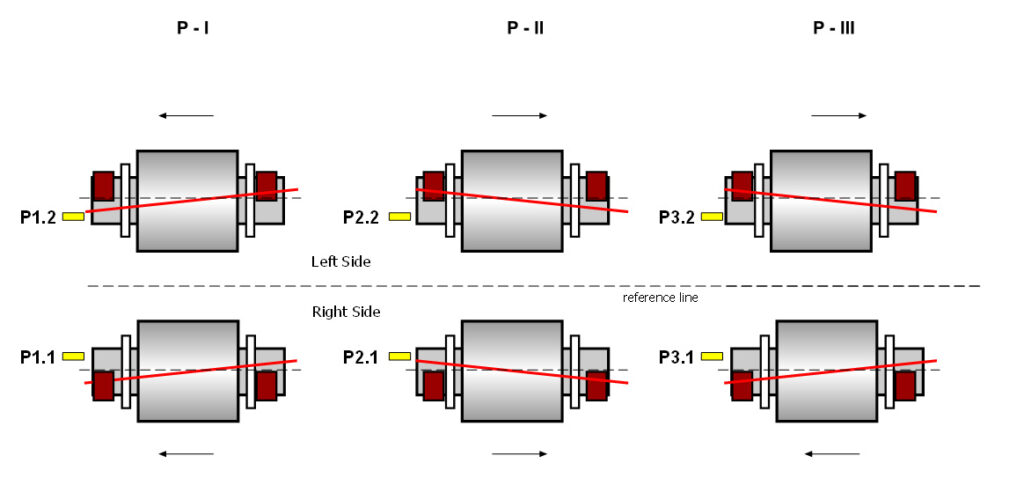
In an ideal situation, both the support rollers and tires running surfaces should be cylindrical and their axes parallel to the main kiln axis. In practice, however, especially after many years of operation of individual components, such a situation is extremely rare. The running surfaces wear out and the axes of the support rollers have a geometrical deviation, causing further damage of the rotary kiln components.
Exceeded tolerances of rollers skewing and inclination lead to rapid wear of support rollers bearings (in particular thrust blocks), where increased axial force creates higher pressure and therefore an increase in temperature of the bearing. Additionally, incorrect geometrical position of the rollers causes a loss of contact between running surfaces of tires and rollers, so that wear of these surfaces is higher and higher. Axial forces generated by incorrect rollers skewing and inclination are transferred directly to the other components. Often the damage or faster mechanical wear appears on side surface of tires and stop-blocks. In the same way these forces are directly transmitted to the thrust roller resulting in faster component wear.
Incorrect kiln balance (e.g. too long operation of kiln in one axial position) also causes accelerated and uneven mechanical wear both running surfaces of support rollers and kiln drive components (pinion and girth gear).